Truth & Reconciliation
In the spirit of truth, justice, and healing, we acknowledge the painful legacy of slavery and racism that has shaped our society—including the ways in which our church, knowingly or unknowingly, has been complicit in these injustices. The Truth and Reconciliation Committee exists as a commitment to acknowledging our history with honesty, seeking forgiveness with humility, and working toward a future rooted in love and reconciliation.
We commit to listening, learning, and taking action so that our church may be a beacon of love, equity, and restoration. Through open dialogue, education, and meaningful engagement with those impacted, we strive to foster healing and deepen our commitment to justice. In doing so, we honor the dignity of every individual and embrace our responsibility to build a future where love, grace, and equality flourish.
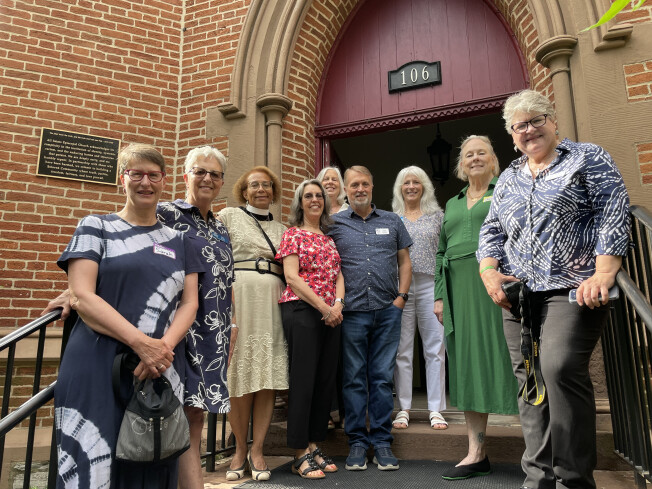
T&R Committee Members
Pictured from left to right: Sarah Heald, Ruth Green, Kim Baker+, Linda Procter, Jill Browning, Rob Cramer, Rixey Hoult, Joan Arnold, Tracy Boyd. Not pictured: Gordon De La Vars+, Stacy Lynskey, Jen Mariano+, Cathy Rogers, Kristen Starr.
The Evolution of the All Saints
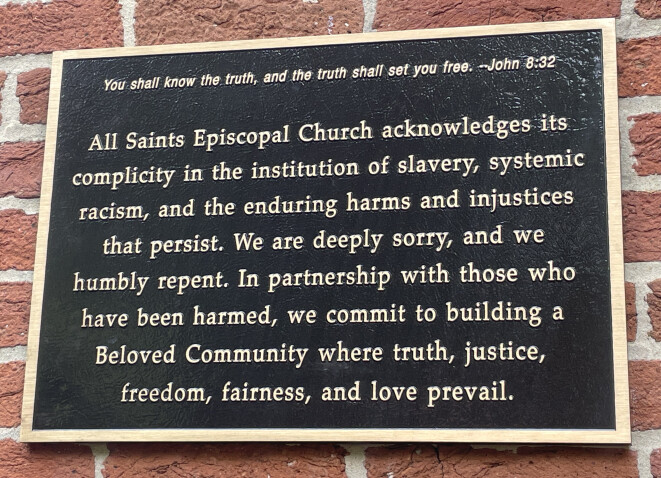
Truth and Reconciliation Plaque Project
Since 2014 following the direction of Diocesan Bishop Eugene Sutton, ASEC parishioners and our T & R committee have learned that prominent All Saints parishioners and vestry members were slaveowners. All Saints had a segregated burial ground, and Blacks were relegated to the balcony to worship in the 1818 Court Street building. (We don’t know what the architecture or the segregation practice was in the original All Saints Street building, but it was likely segregated in some way.) These are just a few examples of historical facts relating to slavery that are recorded in the All Saints archives.
In early 2024 the T & R Committee became aware of how many churches were acknowledging their histories with slavery. We realized the importance of doing something similar. And so, we feel compelled, and we hope our congregation does also, to make a statement about All Saints’ role in the institution of slavery and to apologize for it - publicly. We can only reconcile our past by telling the truth about it, apologizing for our wrongdoings, and committing to doing better. It’s a step toward fulfilling our baptismal vows to strive for justice and peace among all people and respect the dignity of every human being.
We studied markers and plaques as well as consulted with historians, the Episcopal Diocese of Maryland, and African American leaders in our church and the Frederick community to guide us in our initial wording for the All Saints Truth and Reconciliation plaque. In June 2025 the T & R Committee presented the wording to the All Saints congregation for feedback. As a result of that feedback, the wording has been revised to its current language. We believe the revised wording achieves the committee’s objectives:
• to address the past, the present, and the future
• to acknowledge the church's wrongdoing, apologize for it, and promise to do better
Once again, we hope to receive the blessing of our All Saints family. We welcome your feedback.